Start with this question: what happens around the table once people sit down? If a chair cannot pull out properly, someone cannot pass behind it, or a table leg blocks one of the seats, the tabletop technically fitting is not enough.
Measure the dining zone, not just the empty floor
Do not measure only wall to wall. Include the route people actually use between the kitchen, living room, balcony or bedrooms, then allow for chairs when they are occupied and pulled away from the table.
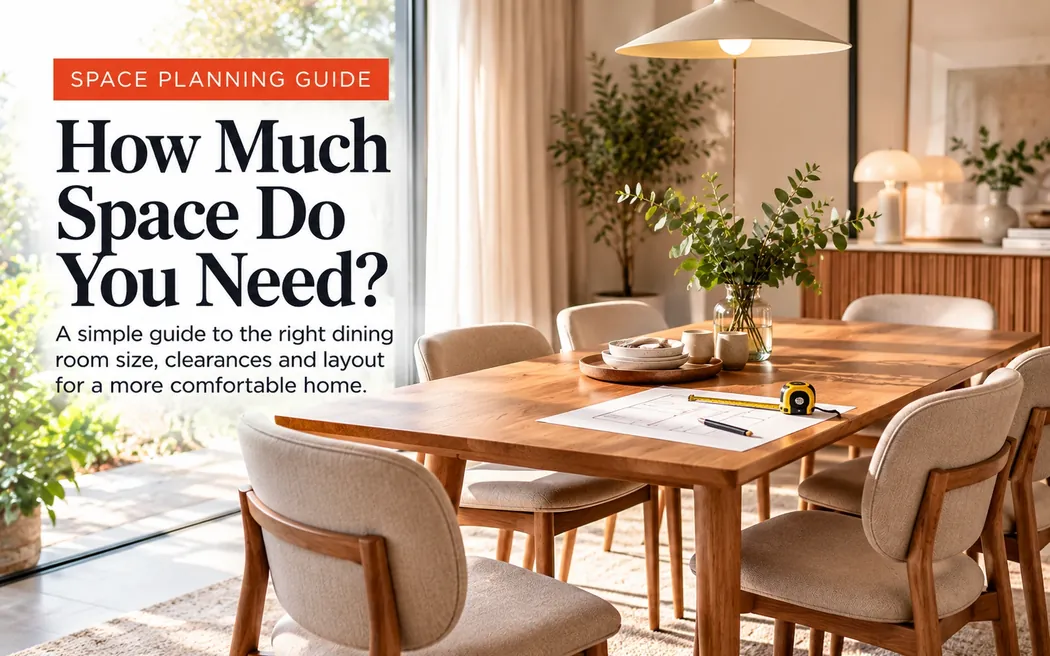
One of the easiest tests is to mark the proposed tabletop on the floor with masking tape, place a chair beside it, sit down and ask someone to walk behind you. If the layout only works when every chair is pushed in, the setup is too large for normal use.
- Check the busiest walking route around the dining area.
- Include sideboards, walls, doors and other fixed furniture.
- Judge the room with chairs in use — not only the tabletop footprint.
Do not trust “6-seater” on its own
Two tables can both be sold as six-seaters but offer very different usable seating. What changes the result is the chair width, table-leg position and usable space between those legs.
If you want three chairs along one side, test three of the actual chairs there. A table can be long enough on paper while one chair still ends up directly against a leg.
Instead of only asking “How many seater is this?”, ask: “How many of these chairs fit comfortably between the table legs?”
Choose the shape from the room constraint
Round does not automatically mean small-space friendly. A large round table needs a broad footprint around it, while a rectangular table can use a narrow dining zone more efficiently.
Rectangular
Worth considering when the dining zone is longer than it is wide, when people sit mainly along two long sides, or when the table helps define an open living-and-dining layout.
Round
Worth considering when the available area is closer to square or when removing corners makes circulation around several sides easier.
Choose the shape that leaves the cleanest movement path, not simply the one that looks smaller in a product photo.
The base can decide whether a seat is actually usable
Before deciding, sit in the middle and end positions. Check whether your knees meet a table leg, whether a deep apron reduces thigh clearance, and whether chairs with arms can slide underneath.
A pedestal base can free up parts of the table edge, but the pedestal or floor plate can still affect foot space. The most reliable test is to sit at the actual table rather than judging the base from a photograph.
Buy for your normal week, not your biggest gathering
If four people use the table every day and eight people visit only occasionally, a permanently oversized table may make the room worse for most of the year.
An extendable table can solve that difference, but only if the room still works at its fully extended size. Check where the extra seats go, whether the table legs move, and whether the extension blocks a main walkway.
Choose the surface after the layout works
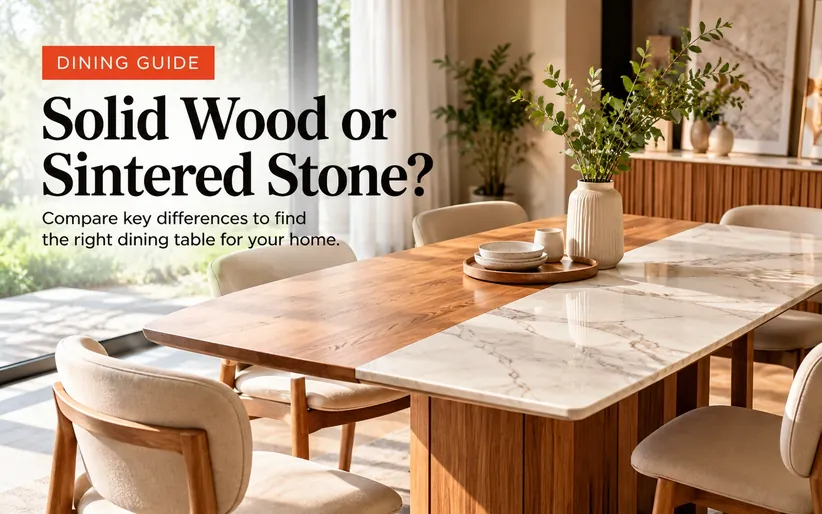
Solid wood
Consider it when natural grain, variation and a warmer furniture character are important to you. See the actual finish in person rather than assuming every “wood” table will look and feel the same.
Sintered stone
Consider it when the dining surface will see frequent meals, drinks, wiping or everyday household activity. Also inspect the edge, support structure and base — not only the surface pattern.
For a deeper material comparison, read Solid Wood vs Sintered Stone Dining Tables.
Five things to test in the showroom
- Sit in every intended seating position.
- Pull the chair out as you normally would at home.
- Check whether the table legs interfere with knees or chairs.
- Try the actual chair-and-table combination you plan to buy.
- If the table extends, open it and check the full size yourself.
When two tables both look good, compare them in this order.
This removes the impractical options first. The design decision becomes easier after that.