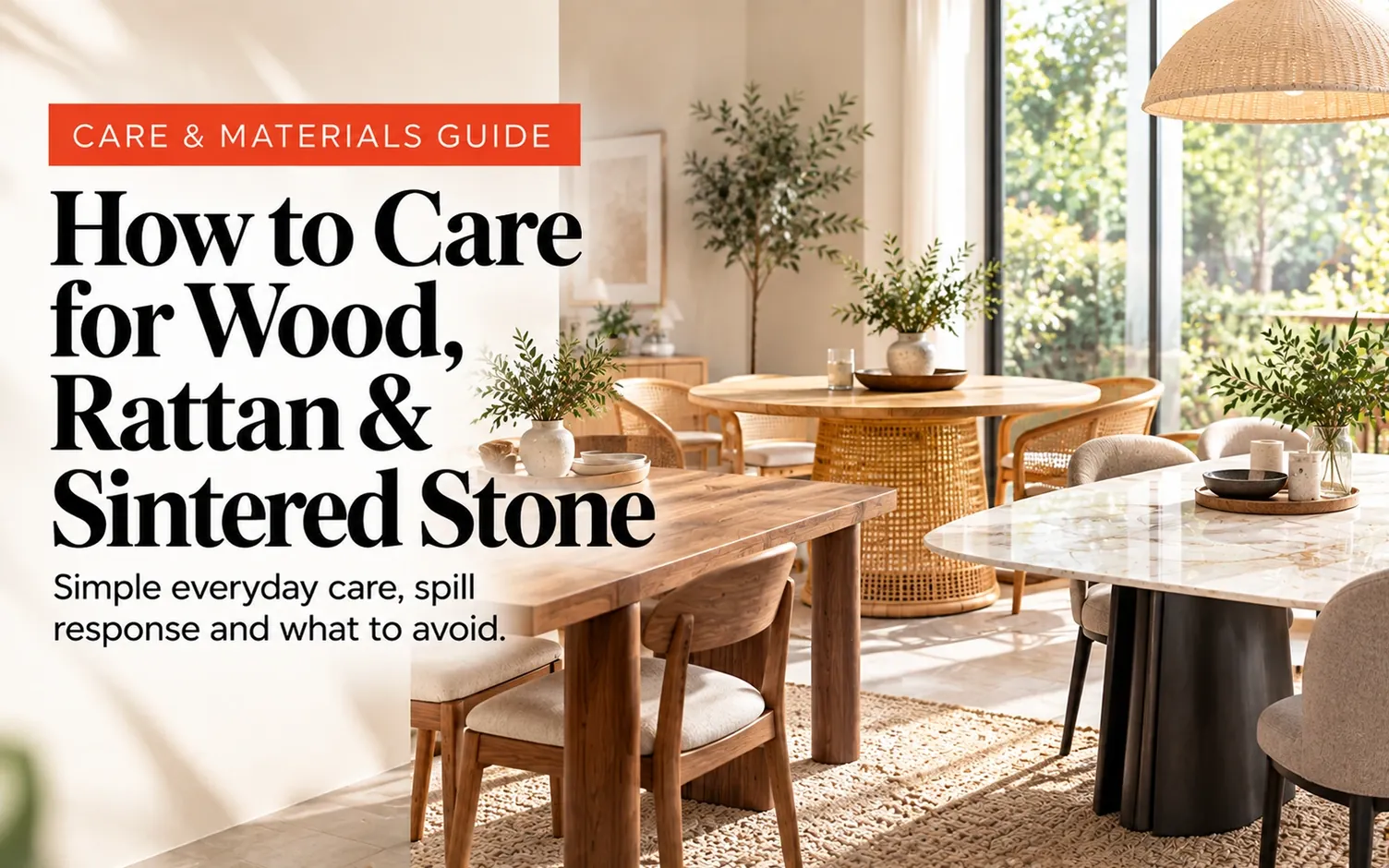
Start by separating appearance from construction. “Rattan furniture” can describe natural rattan, cane or woven details, synthetic rattan-look material, or a combination built over another frame. The useful buying question is not simply “Is this rattan?” It is “Which parts are rattan, what supports them, and is that construction right for how I will use it?”
Do not choose natural or synthetic rattan from appearance alone
Start with where the furniture will be used. Natural rattan gives you the variation, texture and warmth of a plant material. Synthetic rattan is manufactured and is often selected when a piece needs greater resistance to weather exposure.
Best when the natural material is part of the reason you want it
Expect small differences in colour, diameter and texture. Those variations should look intentional and well finished rather than perfectly machine-uniform.
- Usually a stronger fit for indoor or dry, sheltered settings.
- Choose it because you value the material itself, not just the woven look.
Useful when placement demands more from the surface
A synthetic weave can imitate rattan visually while behaving differently around moisture and sun. But the weave alone does not tell you whether the complete item is suitable outdoors.
- Ask what the weave is made from.
- Also ask what frame sits underneath it.
“Which parts of this piece are natural rattan, which are synthetic, and what is the frame made from?” That answer is more useful than the product name alone.
The frame matters more than how much weaving you can see
A woven surface can look impressive while hiding the part doing the real structural work. On chairs, sofas and larger pieces, check how the seat, back, arms and legs are connected to the frame.
Check for movement
Sit down normally and shift your weight once or twice. A little material flex can be normal; obvious looseness at a joint, leg or arm is a different issue.
Check what the weave is attached to
Look underneath or behind the piece. You want to understand whether the weave is decorative, load-bearing or wrapped over another structural frame.
A weather-resistant weave does not automatically make the whole item weather-resistant. If the piece is for a balcony or outdoor setting, ask what the internal frame is made from and whether the complete furniture item is intended for that use.
Look at where the weave ends, turns and joins
The centre of a woven panel is usually the easiest area to make look neat. Corners, edges, the underside and the points where strands terminate tell you more about the finishing.
A wider or more open weave is not automatically lower quality. Different patterns are designed differently. Consistency and clean finishing are more useful checks than simply looking for the tightest weave.
A beautiful rattan chair can still be the wrong chair for you
With woven seating, comfort comes from the whole geometry of the chair — seat depth, back angle, arm height, frame shape and the amount of flex in the woven surface. A cushion can improve comfort, but it should not hide a seating position you dislike.
Check your posture at the table
Sit upright for a few minutes. Make sure the back supports you where you expect it to and the seat does not feel too deep for dining.
Stay long enough to notice pressure points
Do not stand up after ten seconds. Give the chair enough time to notice whether the frame edge, weave or arm position becomes uncomfortable.
If you are buying several of the same chair, test the actual chair model you are buying — not a similar woven chair nearby.
Indoor, sheltered and outdoor are three different buying situations
In Singapore, a balcony can be bright, humid and exposed to wind-driven rain even when it looks “sheltered”. So placement should be confirmed before you buy, especially when natural materials or mixed constructions are involved.
| Planned location | What to confirm before buying |
|---|---|
| Indoor living / dining | Focus on material quality, comfort, finishing and whether the scale suits the room. Natural rattan is commonly considered here. |
| Sheltered balcony | Ask about occasional moisture, direct sun, ventilation and the frame material. Do not assume “under a roof” means indoor conditions. |
| Regular outdoor exposure | Confirm that the complete piece — weave, frame, fasteners and finish — is intended for outdoor use. A rattan look by itself is not enough. |
Detailed cleaning and upkeep belong in the Furniture Care guide. At buying stage, the goal is simply to avoid choosing a material or frame for an environment it was not designed to handle.
Do these five things before you decide from the look
- Ask what is actually rattan.
Natural, synthetic, cane detail, or a mix? - Look underneath.
Identify the frame and how the weave is attached. - Inspect an edge or corner.
Check finishing where strands end or change direction. - Use the furniture normally.
Sit, lean back and notice movement or pressure points. - State the exact placement.
Indoor room, sheltered balcony or outdoor exposure — then confirm suitability.
Buy rattan furniture for the combination of material, construction and comfort — not because the weave looks good in a close-up photograph.